FIELD NOTES / Scientific AI Systems
IMMREP26
I wrote the experiment registry and scheduler and helped keep the held-out epitopes separate during evaluation.
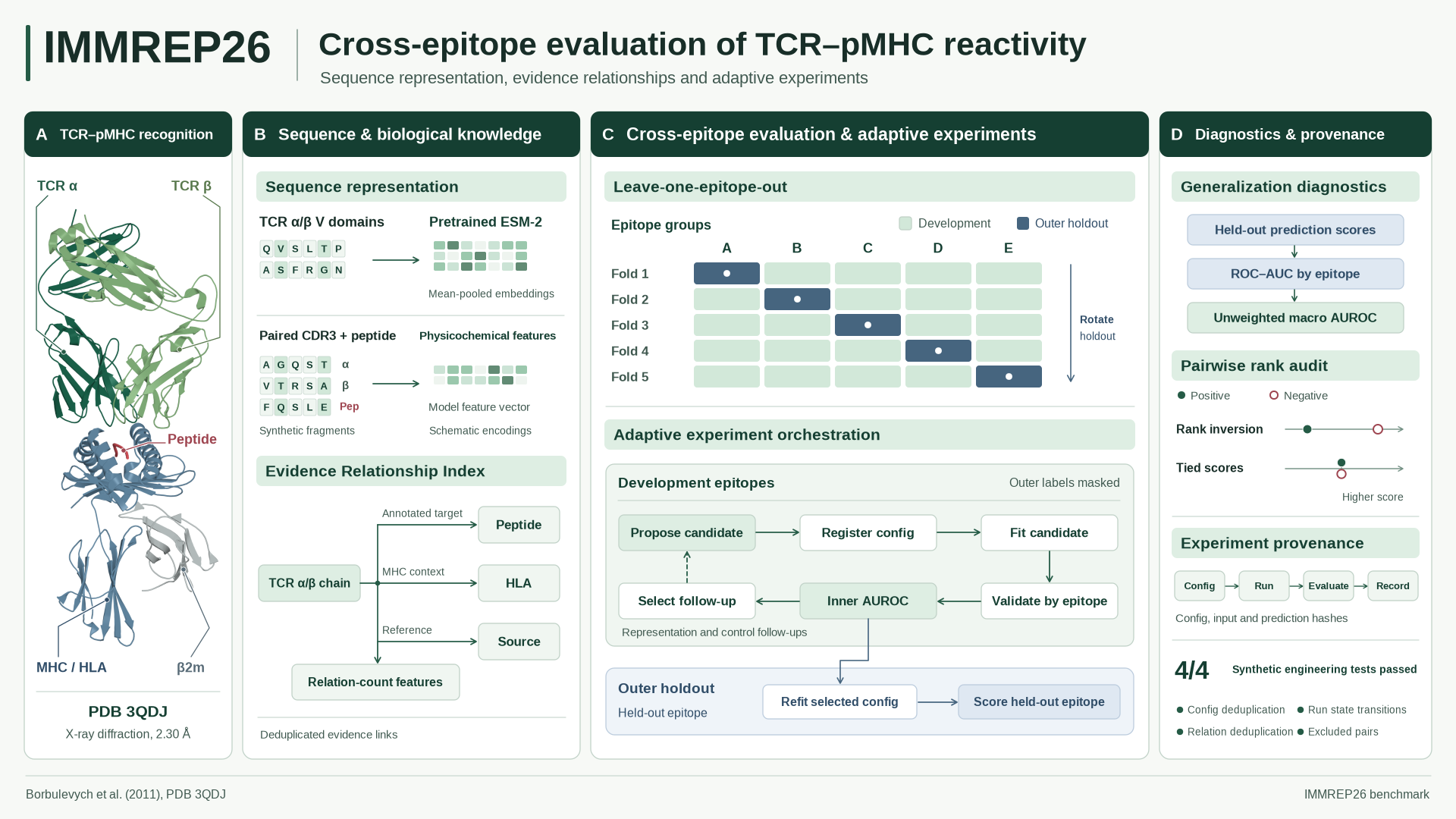
The five-fold matrix shows which epitopes were kept out of development. All four synthetic engineering checks passed on rerun.
View original figureLast reviewed 2026-11-19 · Non-sensitive overview of private work
Cross-epitope evaluation in IMMREP26
Five leave-one-epitope-out folds separate inner model selection from held-out scoring. All 4 synthetic engineering checks passed on rerun. The molecular panel uses PDB 3QDJ as an independent structural reference.
Research Question
How well does a TCR–peptide–MHC reactivity model score an epitope left out of development? Can someone repeat the test?
Technical Approach
The team studied sequence representations and indexed recorded relationships between TCR chains, peptides, HLA and sources. An isolated runner masked outer labels, selected variants using inner evaluation and scored each held-out epitope. Diagnostics include per-epitope ROC–AUC, rank inversions and tied scores.
My Contribution
In the team project, I built persistent experiment registration and scheduling. I helped select follow-up experiments using inner-fold evidence and kept the folds separate. I also wrote graph diagnostics and reproducibility checks.
Evidence
- Four synthetic engineering checks passed on rerun, covering configuration deduplication, run-state transitions, relationship deduplication and pair exclusions.
- Three isolation and replay tests passed, covering held-out label changes, registry resume and the independence of follow-up selection from outer scores.
Outputs
- Cross-epitope workflow and diagnostics figure
- Typed evidence relationship index
- Experiment configuration, run and evaluation records
Current Status
The corrected workflow was evaluated internally across labeled epitopes. Some features can use unlabeled cohort data. Predictive results and competition placements are withheld pending disclosure review.